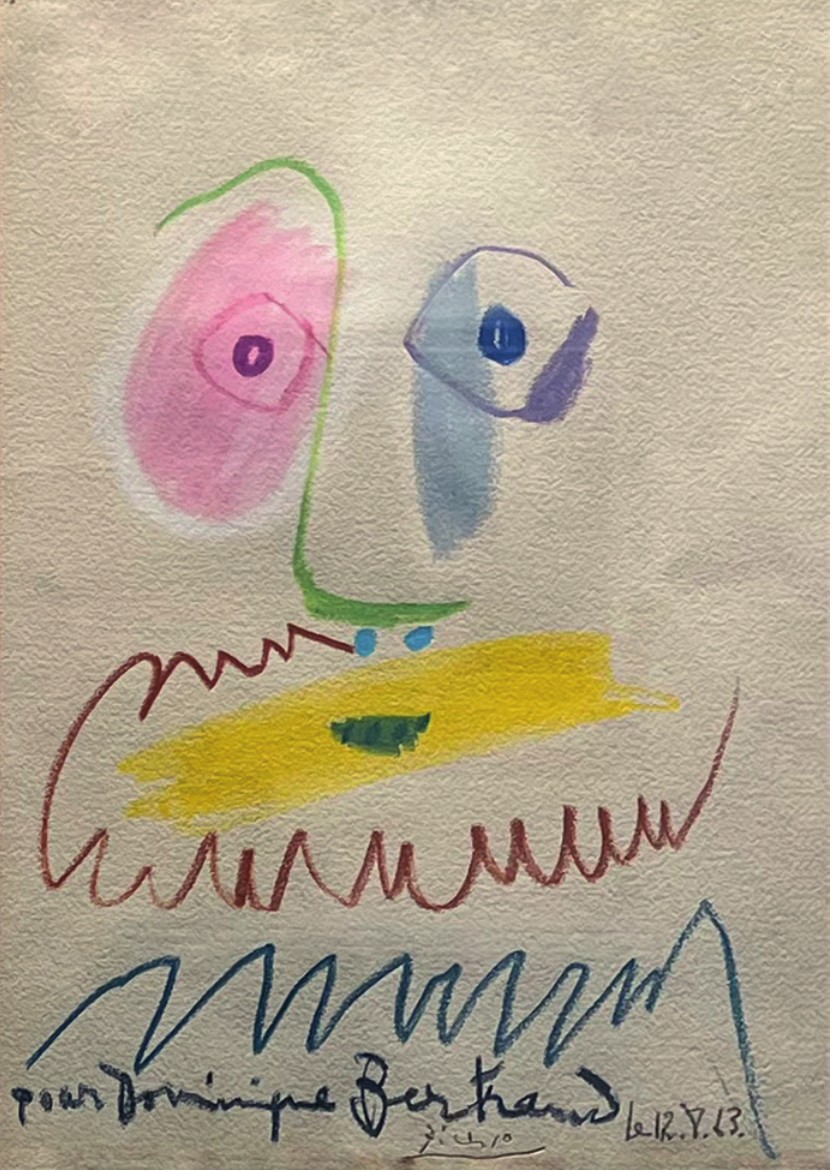
Pablo Picasso (1881–1973), born in Málaga, Spain, and residing in France for most of his life, is considered one of the foremost figures of 20th-century art. As a co-founder of Cubism alongside Georges Braque, he transformed the principles of perspective and reimagined the forms and structures of artistic expression.
His oeuvre, extraordinary in its breadth and diversity, encompasses painting, sculpture, drawing, ceramics, and printmaking, demonstrating an unceasing quest for innovation. Picasso’s prolific output, estimated at nearly 50,000 works, is marked by distinct stylistic periods, including the Blue Period, the Rose Period, and Synthetic Cubism, each reflecting profound inquiries into material, form, and light.
Politically engaged, he created Guernica in 1937, a monumental masterpiece condemning the atrocities of the Spanish Civil War. The work has since become a powerful symbol of resistance and a poignant meditation on the human condition. His collaborations with intellectuals such as Henri Matisse and Jean Cocteau enriched his artistic journey through dynamic exchanges of ideas.
Picasso's influence on generations of artists is immeasurable, and his legacy is firmly entrenched in the history of art. His groundbreaking approaches to composition, his daring exploration of materials, and his boundless creative genius make him a universal and timeless icon. Today, his works, housed in the most prestigious public and private collections, continue to embody the spirit of a modern artistic revolution.